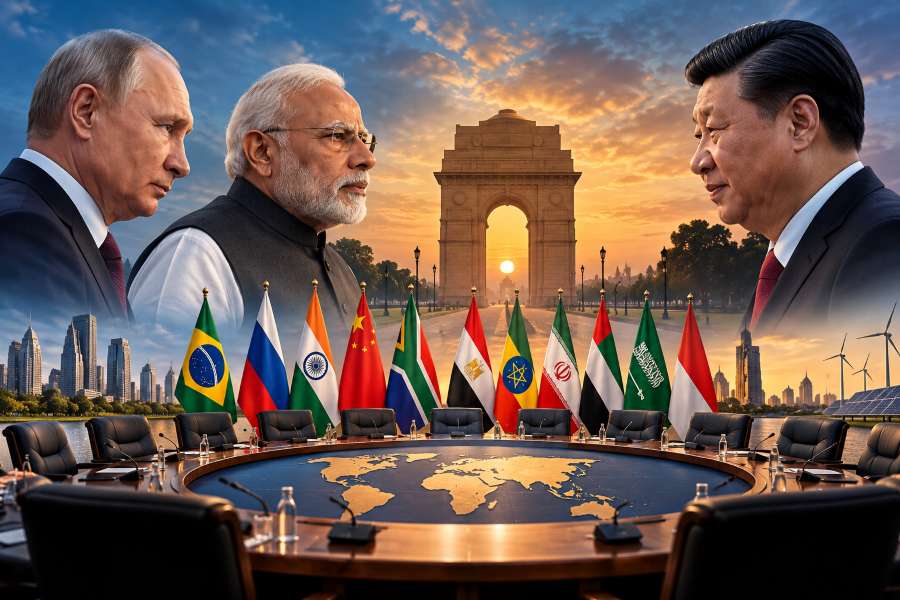
The eighteenth BRICS summit closed at Bharat Mandapam on September 13 with a declaration running to roughly 140 paragraphs, a theme built around resilience and innovation, and a leaders’ photograph that told its own story about how far the grouping has travelled. Xi Jinping and Vladimir Putin were both present, alongside the presidents of Iran, Egypt, Ethiopia and Indonesia and the crown prince of the United Arab Emirates. India then handed the chair to China for 2027, closing a year in which it had convened more than 400 BRICS meetings across thirty cities — a scale of engagement that says something about how seriously the members now treat the machinery between summits.
The arithmetic is what has changed most. The group that met in Delhi is considerably larger than the one that began meeting two decades ago. Egypt, Ethiopia, Iran, the UAE and Indonesia have all joined since 2024, and the bloc now accounts for roughly half of humanity, about 40 per cent of global output measured at purchasing power parity, and something above a quarter of world trade. Weight of that order gives a communiqué a different kind of reach, and it explains why the Delhi text was read closely in capitals well beyond the eleven members.
Consensus as an achievement
The economic sections of the declaration reward careful reading. The members agreed language opposing “unilateral, punitive, discriminatory and protectionist measures that are not in line with international law, such as carbon border adjustment mechanisms” — a reference to schemes that price the carbon content of imported steel, aluminium, cement and fertiliser, and a position that reflects a shared concern among developing economies about the cost of climate measures designed elsewhere. The text presses for restoration of the World Trade Organisation’s dispute settlement system, which has lacked a functioning Appellate Body since 2019, and argues for reform of the Bretton Woods institutions, including a meaningful realignment of IMF quotas under the Seventeenth General Review.
Reaching agreement on that language among eleven governments with genuinely different economic relationships is itself the accomplishment. Several members are in active trade negotiations of their own; the Gulf states, India and Brazil each carry distinct commercial and security ties they are managing carefully. The drafters found formulations that state a shared position on principle while leaving every member room to conduct its own diplomacy. That is how durable multilateral texts are built, and it is why this one holds.
The same balance appears elsewhere. On currency, the declaration endorsed wider use of national currencies in trade settlement and asked the BRICS Payment Task Force to continue work on interoperability between payment and messaging systems — practical, technical progress rather than the common currency that commentary often imagines. On energy, it recorded that fossil fuels “will still play an important role” in members’ energy mix while reaffirming the Paris Agreement, a formulation that accommodates producers and fast-growing consumers alike and reflects the realities of transition in economies still building out basic capacity.
The machinery beneath the communiqué
Beneath the declaratory language sits a layer of institutional work that will shape what the grouping actually delivers. The declaration proposes a BRICS Grain Exchange to improve availability and price transparency in food staples. It welcomes a BRICS Incubator Network and takes forward consideration of a Startup Innovation Fund aimed at Industry 4.0 and technology-enabled sectors. It proposes a shared repository of digital public infrastructure with accompanying pilot projects, endorses a separate Leaders’ Statement on the Global Governance of Artificial Intelligence, and supports an integrated early warning system for mass infectious diseases. A BRICS AGRIN network is to take up farmer-centred cooperation on agricultural inputs and genetic resources, and the New Development Bank is encouraged to mobilise greater resources and expand local-currency financing.
The New Development Bank is the clearest illustration of how this kind of construction proceeds. Established at Fortaleza in 2014 with subscribed capital of $50 billion, operational from Shanghai the following year and supported by a $100 billion Contingent Reserve Arrangement, it has grown steadily and opened its membership well beyond the founding five. Bangladesh, the UAE, Egypt, Algeria and, this year, Uzbekistan have all joined. Regional offices now operate in Johannesburg, São Paulo, Moscow and GIFT City. Twelve years is a short life for a development bank, and the trajectory matters more than any single year’s balance sheet.
What runs through the whole document is patient option-building. Members are developing parallel capacity in payments, trade finance, development lending and technical standards. Each of these lowers transaction costs today and widens the range of choices available tomorrow. That is a sound way for a diverse grouping to proceed, and it is more durable than announcements that outrun institutional capacity.
Opportunities for Pakistan
For Pakistan, the summit’s practical significance lies in the substance rather than the symbolism. Islamabad applied for membership in November 2023 and has had encouragement from Beijing and Moscow; admission is decided by consensus among existing members, and the application stands. In the meantime, several of the Delhi initiatives speak directly to problems Pakistan is working on now, and engagement with them does not wait on a seat at the leaders’ table.
A grain exchange offering better price transparency is of real interest to an economy that imports wheat and edible oil and needs to manage exposure to price swings. Progress on local-currency settlement and payment interoperability is relevant to a country working to ease pressure on reserves and to widen the channels through which trade finance reaches its exporters. A shared repository of digital public infrastructure is well matched to work already under way here on digital identity and instant payments, where Pakistan has practical experience worth both drawing on and contributing.
The New Development Bank offers the most concrete avenue. Its membership has expanded to include countries outside BRICS, and that route is governed by the bank’s own procedures rather than by the summit’s consensus rule. Pursuing membership there, alongside participation in the technical working groups that do much of the grouping’s real work, would put Pakistan inside the institutions that matter operationally while the wider question takes its course.
China assumes the chair in 2027, which will bring its own emphases and its own opportunities for partners across the Global South.For Pakistan the sensible course is steady, practical engagement across several tracks at once — building the technical relationships, joining the institutions that are open, and contributing expertise in the areas where it has something to offer.That approach serves the country’s interests regardless of how the membership question eventually resolves, and it is consistent with a foreign policy that has long drawn strength from keeping many doors open at the same time.
About the Author
Qaiser Nawab is Chairman of the Belt and Road Initiative for Sustainable Development (BRISD), an international platform fostering cooperation and innovation across Asia, Africa, and Latin America. He can be reached at qaisernawab098@gmail.com
Herald Star: Portugal-based news site led by Chief Editor Mr. Rosmel Rodriguez, known for insightful global coverage and a commitment to sustainable development in Europe. Affiliated with influential NGOs, Mr. Rodriguez is an EU Climate Pact ambassador, advocating for sustainable practices. Herald Star delivers high-quality journalism, fostering unity through informative coverage and meaningful conversations on international affairs. Join us for the latest global news and stories, championing sustainable growth in Europe and beyond.