

By Hadia Khan, YOUNGO Reporter
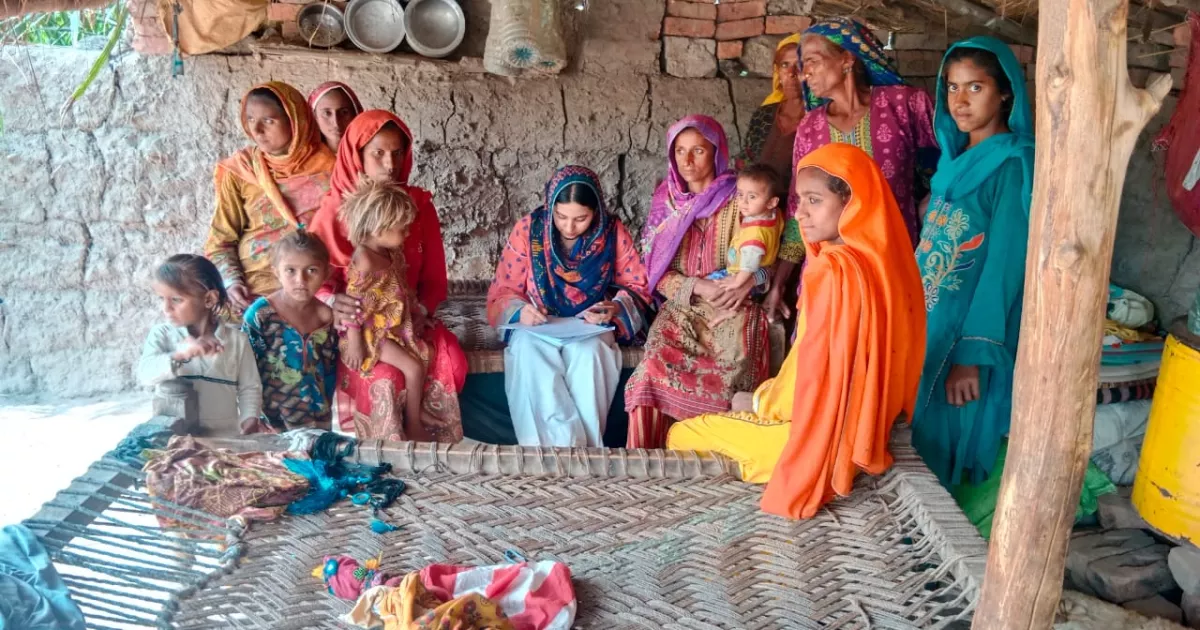
For families living in mountainous and border regions, extreme weather, environmental degradation, damaged infrastructure, declining livelihoods, geographic isolation and existing insecurity can reinforce one another.
Yet people moving under such overlapping pressures may remain poorly understood within conventional discussions of migration and displacement.Rather than treating these experiences simply as community stories, Khan began examining what they meant for law and public policy.
Taking community realities into legal discussions
Her subsequent work has focused on gaps in legal and policy responses to climate-related human mobility, particularly the circumstances of communities whose movement cannot easily be attributed exclusively to either environmental or socioeconomic factors.
Khan has advocated for approaches that place dignity, community participation and protection at the centre of responses to climate-related mobility.
Her work in human rights, legislative awareness, progressive legal reform and climate action was formally recognised in 2025 by the Ministry of Law, Justice & Parliamentary Affairs of the Government of Azad Jammu & Kashmir.
She separately received recognition from the Speaker of the Legislative Assembly of Azad Jammu & Kashmir for contributions including youth advocacy, human rights, legislative awareness, progressive legal reform, climate action, governance and social justice.
For Khan, the significance of bringing these questions into institutional conversations lies in ensuring that policies concerning vulnerable communities are informed by realities outside traditional policymaking spaces.
“When you listen to communities, displacement rarely begins on the day somebody physically leaves their home,” Khan said. “It can begin much earlier—with a livelihood becoming unsustainable, repeated environmental shocks, isolation, damaged infrastructure or the gradual disappearance of choices. Law and policy need to understand that reality.”
From Kashmir to international migration discussions
The concerns Khan encountered locally subsequently became part of her international research and advocacy.
Her work examining the intersection of climate change, conflict and human mobility in Kashmir received international recognition through the Mixed Migration Centre (MMC).Khan’s essay on climate, conflict and mobility in Kashmir was selected through MMC’s Emerging Perspectives initiative and published through its migration research platform, bringing a perspective from an underrepresented border region into a wider international discussion on mixed migration.
Her writing on climate migration has also appeared through YourCommonwealth, where she has argued for greater attention to communities facing displacement and mobility pressures linked to climate change.
The progression—from engagement with vulnerable and border communities, to legal research and advocacy, institutional recognition and international publication—has become a defining feature of her work.
A young voice for communities at the margins
Khan argues that climate-related mobility cannot be addressed only after people have already been displaced.
She advocates greater attention to prevention and resilience, community participation in decisions affecting land and relocation, stronger understanding of multi-causal displacement, and legal and policy responses that recognise the particular vulnerabilities of Indigenous and geographically marginalised communities.
For Indigenous communities especially, she argues, displacement can involve more than losing a house. Land may carry generations of cultural identity, family history, livelihoods and community relationships. Any response to climate-related relocation or displacement therefore needs to consider social and cultural loss alongside physical and economic impacts.
Her approach also challenges the assumption that meaningful migration advocacy must originate in major international centres. Instead, Khan’s work attempts to create a bridge between communities at the geographical margins and institutions where migration policy and narratives are shaped.
“The objective is not to speak for communities whose voices already exist,” Khan said. “It is to help create pathways through which their experiences can reach legal, policy and international spaces where decisions about displacement and protection are being discussed.”
As climate pressures increasingly intersect with livelihoods, inequality and existing vulnerabilities across Pakistan and the wider region, Khan believes young researchers and advocates from affected areas have an important role to play.
Her work continues around a straightforward principle: people should not become invisible simply because their displacement does not fit neatly within an existing legal category.
About Hadia Khan

Hadia Khan is a Kashmiri law candidate, researcher and youth advocate working across human rights, climate justice, migration and sustainable development. Her work focuses particularly on climate- and conflict-related human mobility, vulnerable and Indigenous communities, youth participation and legal reform. Her research and writing have appeared through the Mixed Migration Centre and Your Commonwealth.
Supporting links for editorial reference
Mixed Migration Centre — Climate, Conflict and Kashmir: Invisible Crossings: https://mixedmigration.org/publications/mmr/2025/climate-conflict-kashmir-invisible-crossings/
YourCommonwealth — Hadia Khan correspondent profile: https://yourcommonwealth.org/correspondent/hadia-khan/
