


By Hu Zhoumeng
On March 5, Chinese Premier Li Qiang reaffirmed in the annual government work report that China will enhance services and support for foreign-funded enterprises to ensure it is a favored destination for foreign investment. For international capital constantly reassessing risks amid uncertainty, the message served as welcome reassurance.
Early 2026 has already witnessed a wave of new foreign-invested projects across China. From Guangzhou to Suzhou, and from Foshan to Zhuhai, multinational companies have announced expansions and new facilities. South Korea’s STI aims to build a power semiconductor manufacturing base in Guangzhou. British manufacturer McGavigan has planned a research and production hub for high-end electronics and automotive labels in Suzhou. U.S.-headquartered Allied Mineral Products secured an industrial land bid in Foshan, and Germany’s Covestro launched a new thermoplastic polyurethane production facility in Zhuhai.
Individually, these investments may not draw much attention. Yet collectively, they signal a noteworthy trend. While some Western media outlets have exaggerated the narrative of “foreign capital withdrawing from China,” companies making real-world investment decisions rarely follow such headlines. Instead, they weigh factors such as the business environment, supply-chain efficiency, and long-term return potential.
Rebalancing, Not Retreating
In recent years, global economic uncertainty has intensified, financial conditions have tightened, and trade growth has slowed. Against this subdued global investment backdrop, fluctuations in the scale of foreign investment flowing into China are hardly surprising. What matters more is how the structure of that investment is evolving.
According to China’s Ministry of Commerce, more than 70,000 new foreign-invested enterprises were established nationwide in 2025, a year-on-year increase of 19.1 percent. A closer look shows that foreign investment expanded significantly in high-tech industries, with actual utilized foreign investment in the sector exceeding 240 billion yuan (about US$34.8 billion). E-commerce services surged by 75 percent while sectors such as medical devices and aerospace also recorded robust growth.
Rather than a wholesale withdrawal, foreign capital appears to be rebalancing in step with China’s ongoing economic transformation.
Relocation of some labor-intensive production to lower-cost regions is a common feature of evolving global division of labor. At the same time, the continued establishment of R&D centers, high-end manufacturing facilities, and regional headquarters suggests that multinational corporations are strategically repositioning themselves within the Chinese market. They are increasingly shifting from a cost-driven approach toward one centered on capabilities, moving beyond simple scale expansion to focus on technological competitiveness and deeper market engagement.
Corporate sentiment reflects this shift. According to the German Chamber of Commerce in China, 93 percent of surveyed German companies planned to continue expanding their presence in the Chinese market, with more than half intending to increase investment over the next two years. A report from the American Chamber of Commerce in China showed that 52 percent of respondents still ranked China among their top three global investment destinations — four percentage points higher than the previous year. As president of the chamber Michael Hart noted, China remains a highly competitive supply-chain base with multiple advantages, including its vast consumer market.
Innovation and Market Scale: A Dual Engine
To better understand the logic behind these decisions, an ideal case study is German optics giant ZEISS.
In February 2026, ZEISS launched its largest single infrastructure investment in China to date. The project will create a comprehensive campus in Shanghai integrating research, production, and service functions. For a company with annual revenues exceeding 10 billion euros (about US$11.6 billion) and a high level of automation, such a move clearly rises beyond cost considerations.
The decision reflects China’s strengths in three areas: a deep talent pool in engineering, a mature and efficient supply-chain ecosystem, and a relatively stable policy environment. Together, these elements enable companies to foster the capability to translate laboratory breakthroughs into scalable, compliant products at remarkable speed. In essence, China offers an integrated industrial collaboration network that links research, development, and mass production.
A growing number of multinational corporations are recognizing China’s evolution from a traditional manufacturing base or sales market into a major hub within the global innovation network. Across sectors ranging from artificial intelligence and the digital economy to green technology, biopharmaceuticals, and advanced equipment manufacturing, China provides not only enormous demand but also a wealth of real-world scenarios in which new technologies can be tested and refined.
For businesses seeking to ride in the latest wave of technological transformation, this industrial ecosystem has become a strategic asset. Experience and capabilities gained in China often translate directly into stronger competitiveness in the global market.
Three Sources of Long-Term Certainty
For global companies navigating rising protectionism and intensifying geopolitical tensions, certainty, not profits, has become the scarcest commodity. So how does China generate such a sense of certainty and stability?
The first generator is macroeconomic resilience. According to this year’s government work report, China’s GDP has crossed successive thresholds, topping 110 trillion, 120 trillion, 130 trillion, and 140 trillion yuan over the past five years, with an average annual growth rate of 5.4 percent, well above the global average. In 2025, total retail sales of consumer goods surpassed 50 trillion yuan (about US$7.2 trillion). Even as the economy undergoes structural adjustment, China continues to generate steady growth and commercial opportunities through its vast domestic market.
The second source is a stable policy environment. The report shows that China has lifted all access restrictions on foreign investment in the manufacturing sector over the past five years and will expand market access and open up more areas, particularly in the service sector, in 2026. China will expand opening-up trials for value-added telecom services, biotechnology, wholly foreign-owned hospitals, and other fields, and take well-ordered steps to expand opening up in the digital sector. In recent years, a range of measures — from expanding the Catalog of Encouraged Industries for Foreign Investment and holding regular roundtable meetings with foreign companies hosted by the Ministry of Commerce, to offering tax incentives for reinvested profits — have enhanced policy transparency and regulatory continuity.
The third source is a clear vision of industrial upgrading. The year 2026 marks the beginning of China’s 15th Five-Year Plan period (2026–2030). With priorities such as expanding domestic demand, technological innovation, the digital economy and green transformation, policymakers are outlining the country’s medium- and long-term development trajectory — a topic currently under discussion during the ongoing “two sessions,” the annual sessions of China’s top legislature and political advisory body. For companies making long-term strategic investments, operating in China where development goals are advanced steadily through structured five-year cycles can provide a clearer sense of policy direction.
When an economy combines sustainable growth potential, a stable policy environment, and a clear direction for industrial development, its appeal to global capital seldom wanes.
In turbulent global economic waters, companies are not looking for perfectly safe harbors. Instead, they seek a main shipping lane capable of carrying them through economic cycles. Many foreign investors have increased their stakes in China precisely because they believe the country remains firmly on that route — and that the channel ahead continues to widen.
The author is a commentator with the Center for Europe and Asia (China Pictorial Publications) of China International Communications Group.
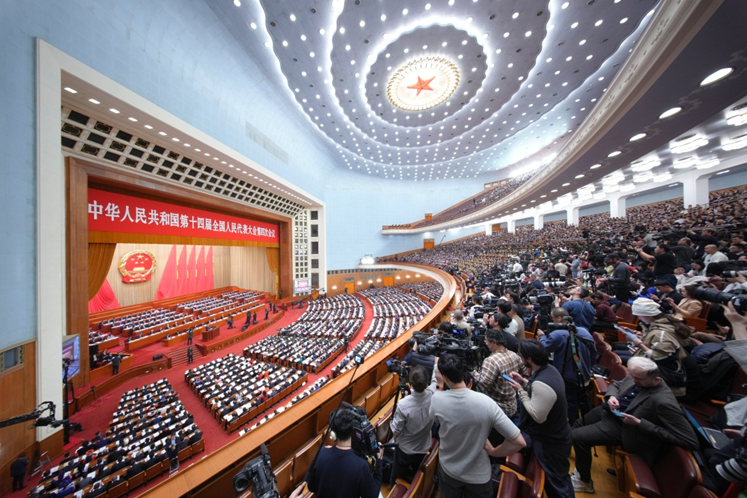
The opening meeting of the fourth session of the 14th National People’s Congress is held at the Great Hall of the People in Beijing, March 5, 2026. (Photo by Wan Quan/China Pictorial)
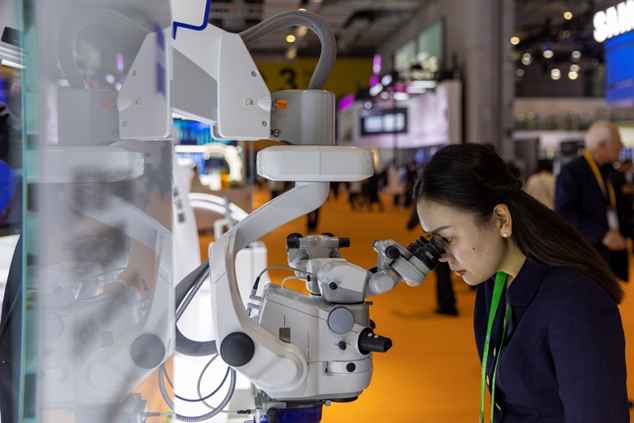
A visitor checks out medical equipment at the ZEISS Group booth during the 8th China International Import Expo held in Shanghai, November 2025. The German manufacturer of optical systems and optoelectronics has participated in the expo for eight consecutive years. (Photo by Duan Wei/China Pictorial)
